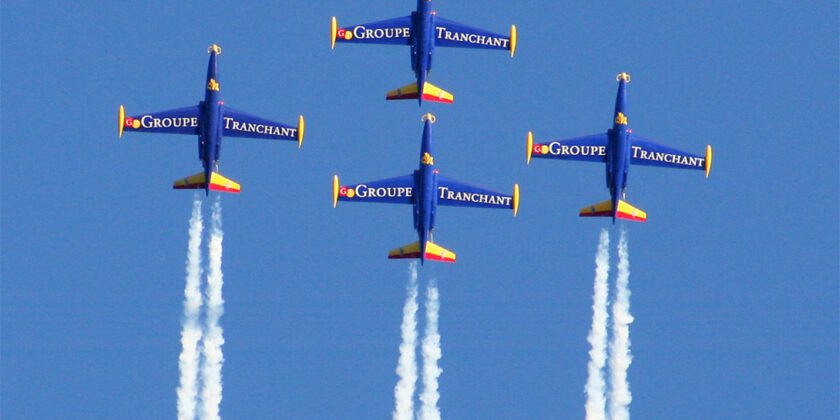
Fouga CM170, F-GPCJ

Fouga CM170, F-GPCJ

An iconic silhouette in the French sky The CM-170 Fouga Magister is one of the most iconic jet trainers of the 20th century. Designed in France in the 1950s, it was developed to train military pilots on new jet aircraft. Its sleek appearance, distinctive V-shaped tail (also known as a "butterfly") and flight performance made it as elegant as it was efficient. An ambassador for French wings The Fouga trained generations of French Air Force pilots and was also exported to more than 20 countries, becoming a global success. It remains famous for having been used by the Patrouille de…
Read More
Zéphyr CM 175

Zéphyr CM 175

Naval elegance with jet propulsion The CM 175 Zéphyr is a jet trainer aircraft developed in the 1950s for the French Navy. A naval derivative of the Fouga Magister, it was designed for training carrier-based fighter pilots, with specific adaptations for catapult launch and carrier landing. Elegant, sleek and with distinctive lines, the Zéphyr made its mark on naval aviation history. An aircraft designed for the flight deck Commissioned in 1959, the Zephyr was designed to train French Navy pilots in the particularly demanding task of landing on aircraft carriers. Equipped with structural reinforcements, a tail hook and a reinforced…
Read More
Boeing Stearman, F-HIZI

Boeing Stearman, F-HIZI

A timeless classic Introduced into service in the mid-1930s, the ‘Stearman’, became the benchmark training biplane for future fighter, bomber and reconnaissance pilots. With its sturdy steel and wood airframe, wide fixed undercarriage and responsive controls, it was ideal for learning the basics of flying: take-off, navigation, tight turns, basic aerobatics and even... less-than-perfect landings! Flying with Aero Vintage Academy Registered F-HIZI, this Stearman has been expertly restored to the bright yellow livery of USAAF training aircraft. It is now available for discovery flights, giving anyone with an interest in flying the old-fashioned way the chance to try it out.…
Read More
North American T-6, F-HLEA

North American T-6, F-HLEA

A legend in military training Nicknamed the ‘Pilot Maker’ by the Americans, the T-6 Texan (or Harvard in Commonwealth countries) trained thousands of Allied pilots during the Second World War and beyond. An advanced training aircraft, it was used to learn the complex manoeuvres required to fly fighters such as the P-51 Mustang and the Spitfire. Its tandem cockpit, sliding canopy and ability to simulate the behaviour of combat aircraft made it an essential part of military pilot training. Flying with Aero Vintage Academy F-HLEA, based at La Ferté-Alais, is operated by the passionate team at Aero Vintage Academy. In…
Read More
Fouga CM170, F-AZQC

Fouga CM170, F-AZQC

An iconic silhouette in the French sky The CM-170 Fouga Magister is one of the most emblematic jet trainers of the 20th century. Designed in France in the 1950s, it was developed to train military pilots in the new jet aircraft. Its slim appearance, characteristic V-shaped tail (also known as a ‘butterfly’) and flight performance made it an aircraft that was as elegant as it was efficient. An ambassador for French wings The Fouga trained generations of French Air Force pilots and was also exported to more than 20 countries, becoming a worldwide success. It remains famous for having equipped…
Read More
TB-30 Epsilon, F-AYOB

TB-30 Epsilon, F-AYOB

TB-30 F-AYOB The Socata TB 30 Epsilon is a light military trainer aircraft produced by SOCATA (then part of Aérospatiale). It is a tandem two-seater with a metal airframe. The first prototype flew on 22 December 1979.In 1978, the French Air Force (Armée de l'Air) published a requirement for a new basic trainer aircraft to partially replace the Fouga Magister in the early parts of the syllabus for pilot training.The Armée de l'Air placed an initial order for 30 Epsilons in 1981, with further contracts following with a total of 150 ordered.General characteristicsLength: 7.59 m (24 ft 11 in)Wingspan: 7.92 m (26 ft 0 in)Empty weight:…
Read More
T-6, D-FAME

T-6, D-FAME

  T-6 DFAME   T-6 DFAME   T-6 DFAME   D-FAME AT-6 Harvard was constructed in 1952 with Canadian Car & Foundry. Construction number CCF-4-77. The Harvard MK.IV was handed over to the Royal Canadian Airforce RCAF in 1952 with Serial number RCAF 20286. The aeroplane was in RCAF service until 1968. From 1969 until 1983, she was based in the US with registration N13631. It was also flown as a “Reno-Racer” # 88 named “Super Slug”. 1983 – 1996 it was registered in the UK as G-BKCK. In 1997 it was bought by Achim and Elmar Meier (Meier Motors…
Read More
T-6, F-AZTL

T-6, F-AZTL

  History of the T-6 Texan Developed in the late 1930s, the T-6 Texan was the training aircraft for several generations of pilots, playing a key role in military pilot training. Between 1935 and 1945, more than 15,000 units were produced by North American in the United States and used by nearly 30 countries (France, China, Australia, Great Britain, Honduras, Canada, etc.). In France, it was used at the Marrakech and Cognac training bases before being replaced by the Fouga CM 170. It was also used in operations in Algeria and Morocco in the fight against guerrilla warfare (1956–1960). Its…
Read More
Stampe SV-4, F-AYGG

Stampe SV-4, F-AYGG

  Stampe F-AYGG© Bruno Muthelet                 Stampe F-AYGG   Stampe F-AYGG   Stampe F-AYGG   Stampe F-AYGG   The Stampe SV-4 is an aerobatic training biplane. It was designed by Belgian Jean Stampe and Maurice Vertongen, who started producing it in 1937. After the war, France produced nearly a thousand. SNCAN (Société Nationale des Constructions Aéronautiques du Nord) manufactured 701, and the AIA (Industrial Aeronautics Workshop) of Algiers 150, including the one presented here. The Air Force presentation squadron, ancestor of the Patrouille de France, was even equipped in 1947. F-AYGG, built in…
Read More